
Understanding the Window of Tolerance: Why Behaviour is Often a Nervous System Story
As parents, we are often taught to look at behaviour as a choice. If a child is shouting, refusing, running away, lashing out or completely shutting down, our instinct is to ask:
“How do I stop this behaviour?”
But what if the more useful question is:
“What is their nervous system telling us right now?”
The concept of the Window of Tolerance, developed by psychiatrist Dan Siegel, helps us understand why children – and adults – can sometimes access their thinking brains and at other times seem completely overwhelmed by emotions, demands or stress.
For parents of autistic, PDA, ADHD and otherwise neurodivergent children, this framework can be particularly helpful because many of our children spend large parts of their day managing sensory, social, emotional and cognitive demands that others may not even notice.

What is the Window of Tolerance?
The Window of Tolerance refers to the zone in which our nervous system is regulated enough for us to think, learn, communicate, problem-solve and connect with others.
When we are within our window, we can experience emotions – even big emotions – without becoming overwhelmed by them. We are able to respond rather than react.
Inside the window, we are more likely to:
- Think clearly
- Access language
- Be flexible
- Learn new information
- Connect socially
- Regulate emotions
For children, this is often the state where cooperation, learning and communication become possible.
What Happens Outside the Window?
According to Siegel’s model, there are two primary states outside the window.
Hyperarousal: “Too Much”
This is the nervous system’s activation state. The brain perceives danger – whether that danger is real or simply felt.
Children may appear:
- Angry
- Anxious
- Defiant
- Aggressive
- Hyperactive
- Controlling
- Panicked
- Tearful
Their fight or flight system is activated.
The thinking part of the brain (the prefrontal cortex) becomes less accessible while survival systems take over.
A PDA Child in hyperarousal might:
- Refuse every request
- Lash out verbally
- Become controlling
- Demand certainty
- Argue intensely
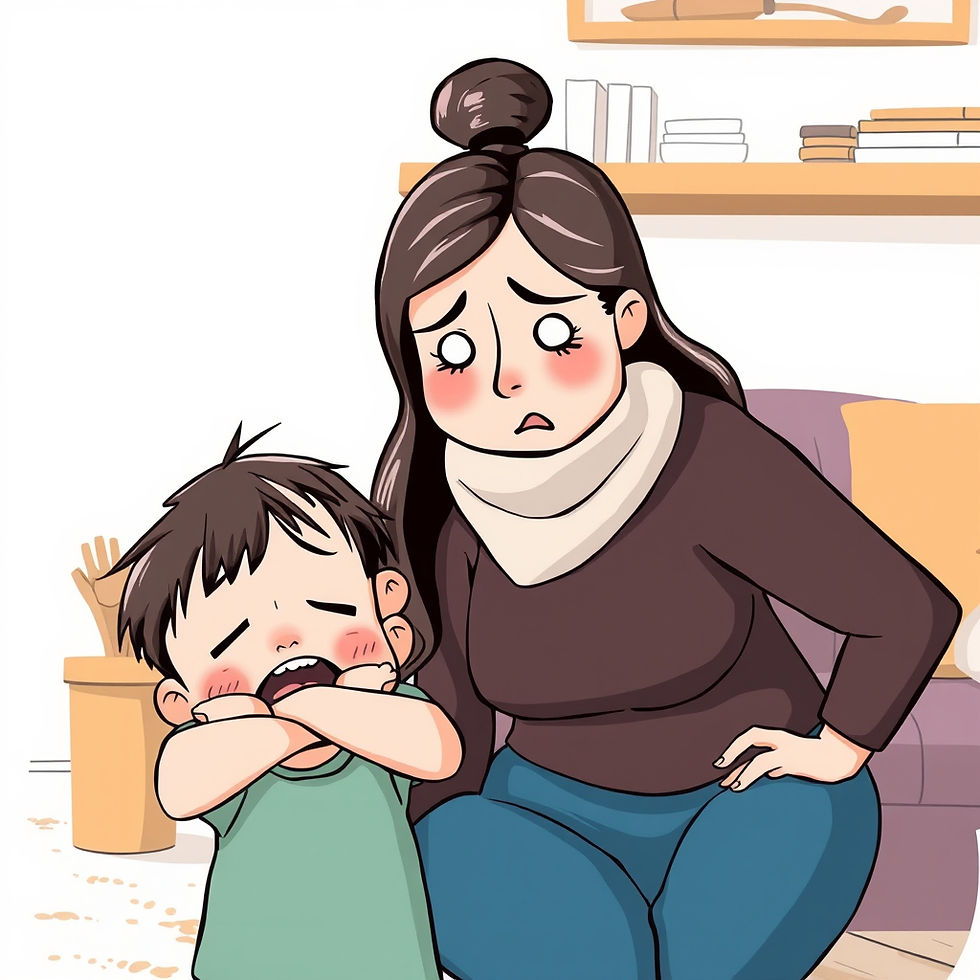
- Run away
- Experience explosive meltdowns
From the outside, it can look like challenging behaviour.
From the inside, it often feels like threat.
Hypoarousal: “Too little”
If stress becomes too overwhelming, the nervous system may move into shutdown response.
Children may appear:
- Quiet
- Withdrawn
- Frozen
- Numb

- Exhausted
- Disconnected
- Disassociated
- Unresponsive
This is often described as the freeze or fawn response.
A child may:
- Stare blankly
- Hide under a blanket
- Refuse to speak
- Seem lazy
- Fall asleep after a stressful event
- Avoid all interaction
Again, this is not a behavioural choice.
It is a nervous system response.
The Brain Science Behind It
When we feel safe, the prefrontal cortex – the area responsible for planning, reasoning, emotional regulation and flexible thinking – remains online.
When our nervous system detects a threat, survival systems become prioritised.
The brain essentially asks:
“Do I need to survive this, or can I think about it?”
When the answer is survival, reasoning takes a back seat.
This is why a child in meltdown cannot simply “calm down and explain what’s wrong”.
Their nervous system is prioritising protection over communication.

Why Neurodivergent Children Often have Narrower Windows
Every person has a different sized window of tolerance.

Factors that can narrow a child’s window include:
- Sensory overwhelm
- Sleep deprivation
- Anxiety
- Trauma
- Chronic Stress
- Unmet Needs
- Social Demands
- Felling misunderstood
- Frequent experiences of failure
Research and clinical observations suggest that trauma and chronic stress can significantly narrow the window, meaning smaller stressors push a person into survival states more quickly.
For many autistic and PDA children, everyday experiences can already require enormous amounts of effort.
By the time they get home from school, they may have very little nervous system capacity left.
What looks like an overreaction may actually be the final straw.
My 6 year old will often throw a meltdown over (what I feel is) the smallest thing. "You've cut my sandwich into triangles, not SQUARES!"
"My sock is weird!"
"She's sitting in MY seat!!"
The Window of Tolerance and PDA
For PDA children, demands themselves can trigger a threat response.
This does not mean they are choosing to be difficult.
Their nervous system may genuinely interpret expectations, uncertainty, loss of autonomy or feeling trapped as threats.
When this happens, the child may rapidly move outside their Window of Tolerance.
Parents often notice that:
- The more pressure applied, the worse things become
- Logic stops working
- Consequences escalate distress
- Flexibility disappears
This is exactly what we would expect when a nervous system has shifted into survival mode.
The child is no longer accessing the situation primarily through reasoning.
They are responding through threat detection.
Co-Regulation Before Self-Regulation
One of the most important findings from developmental psychology is that children learn regulation through relationships.
Before children can self-regulate, they require co-regulation.
Psychologists describe co-regulation as the process by which a calm, regulated adult helps a child’s nervous system return to safety.
Note: “A calm, regulated adult” If you are not feeling calm, if you are dysregulated – Co-Regulation will not be effective
This might look like:
- Sitting quietly nearby
- Reducing demands
- Using a calm voice
- Offering reassurances
- Lowering sensory input
- Providing connection without pressure
In these moments, our calm nervous system becomes an anchor for theirs.
How Parents can Support a Child Back Into Their Window
When a child is dysregulated, the goal is not compliance.
The goal is regulation.
Helpful approaches might include:
When a child is hyperaroused
- Reduce language
- Lower demands
- Slow your voice
- Offer movement
- Create physical safety
- Focus on connection rather than correction
When a child is hypoaroused
- Offer gentle sensory input
- Sit nearby without pressure
- Encourage movement if tolerated
- Use warmth and curiosity
- Allow recovery time
Only once a child has returned to their window does problem-solving become effective.

A Different Way to View Behaviour
The Window of Tolerance invites us to move away from asking:
“What’s wrong with this child?”
And towards asking
“What is happening to this child’s nervous system?”
The shift can completely transform how we respond.
Because when we understand behaviour as communication from a nervous system, our role changes.
We stop trying to force regulation. Instead, we create the conditions where regulation becomes possible.
And often, that is where the real progress begins.
Becky x
References:
- Dan Siegel (1999, 2012). Development of the Window of Tolerance concept. Iptrauma.org
- Pat Ogden adapted and expanded the concept within trauma treatment frameworks
Discussion of hyperarousal, hypoarousal and optimal regulation states.


Comments